A Technical Guide to AI-Powered Investing and Portfolio Management
An objective analysis of how machine learning, algorithmic trading, and robo-advisors function within modern financial markets, including technical mechanisms and inherent limitations.
adhikarishishir50
Published on January 24, 2026
The Fundamentals of AI-Powered Investing
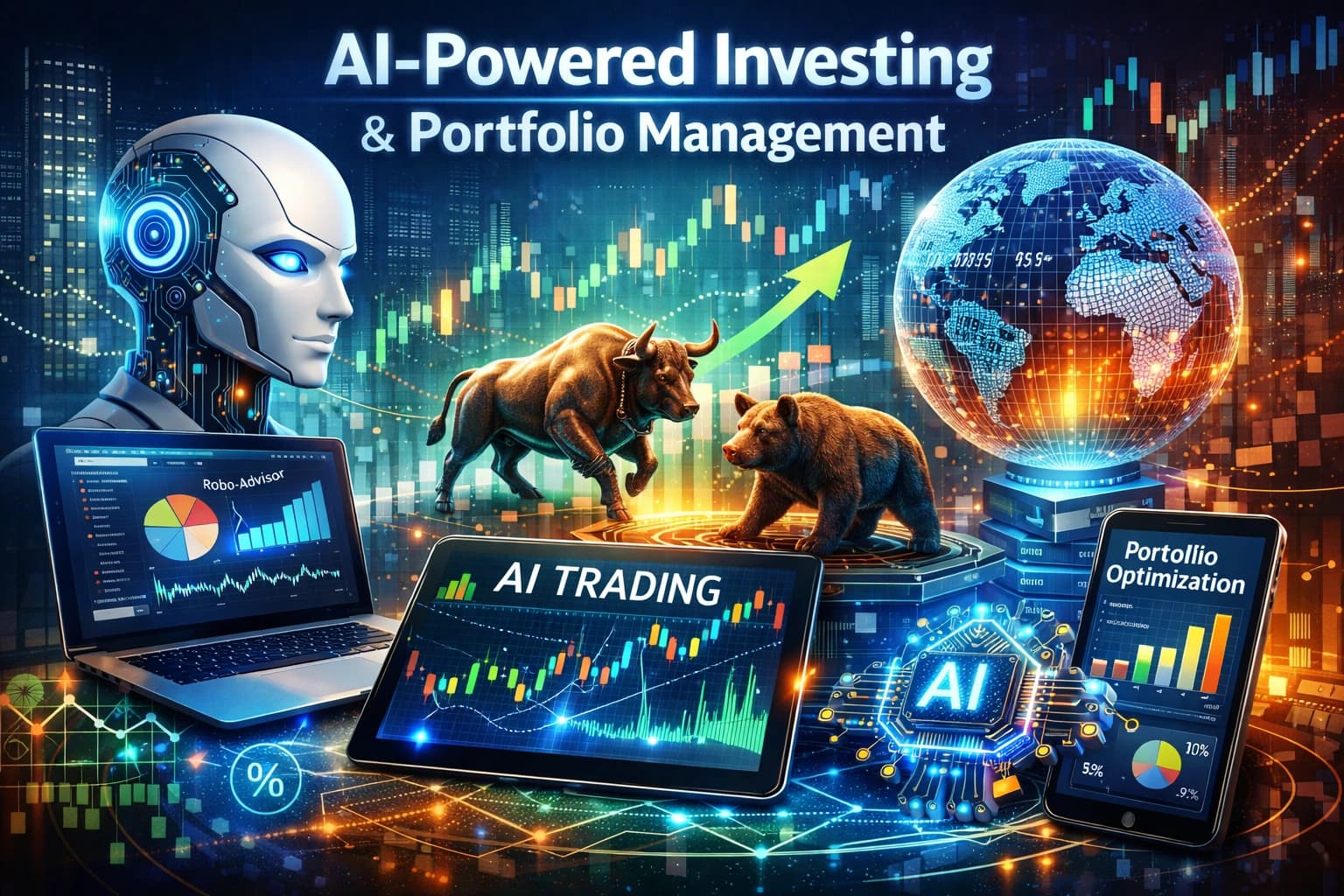
AI-powered investing refers to the use of machine learning (ML) and automated algorithms to make financial decisions. It replaces or assists human judgment with data-driven models. These systems process vast datasets to identify patterns that human analysts often miss. In modern finance, this technology manifests in three primary areas: retail robo-advisors, institutional algorithmic trading, and advanced portfolio optimization.
Traditional investing relies on fundamental analysis and human intuition. AI-powered investing relies on statistical probability and computational speed. The goal remains the same: maximizing returns while minimizing risk. However, the methodology differs through the use of non-linear models and real-time data processing.
How Robo-Advisors Manage Assets
Robo-advisors are digital platforms that provide automated, algorithm-driven financial planning services. These systems require little to no human intervention. They function by collecting information from users about their financial goals and risk tolerance. The software then uses this data to offer advice and automatically invest user assets.
Portfolio Construction and Asset Allocation
Most robo-advisors use Modern Portfolio Theory (MPT) to build a diversified portfolio. MPT suggests that an investor can maximize returns for a specific level of risk by diversifying across different asset classes. The AI determines the ideal mix of stocks, bonds, and real estate based on the user's profile. It executes trades to establish this balance immediately.
Automated Rebalancing and Tax-Loss Harvesting
Market movements eventually drift a portfolio away from its original target allocation. AI systems monitor these shifts daily. When an asset class exceeds a specific threshold, the algorithm automatically sells high-performing assets and buys underperforming ones. This process, known as rebalancing, maintains the intended risk level. Additionally, many systems perform tax-loss harvesting. This involves selling securities at a loss to offset capital gains taxes, a task that is computationally difficult for humans to perform manually across thousands of accounts.
Mechanisms of Algorithmic Trading
Algorithmic trading uses a computer program that follows a defined set of instructions to place a trade. These instructions consider timing, price, and quantity. Unlike a human trader, an algorithm can execute orders at speeds and frequencies that are impossible for a person. This technology manages the majority of trade volume on global stock exchanges.
Execution Strategies
Traders use algorithms to break large orders into smaller chunks. This prevents the market price from moving too sharply in response to a single large trade. Common strategies include Volume Weighted Average Price (VWAP) and Time Weighted Average Price (TWAP). The AI analyzes liquidity and volatility to determine the optimal moment for each micro-trade.
High-Frequency Trading (HFT)
HFT is a subset of algorithmic trading characterized by high speeds, high turnover rates, and high order-to-trade ratios. These algorithms capitalize on minute price discrepancies between different exchanges. Success in HFT depends on low latency. The AI processes market data and executes orders in microseconds. These systems do not hold positions overnight; they profit from many small gains throughout the trading session.
Machine Learning in Financial Analysis
Machine learning finance moves beyond simple rule-based algorithms. It allows systems to learn from historical data and improve their performance over time without being explicitly programmed for every scenario.
Supervised Learning for Price Prediction
In supervised learning, developers train a model on labeled historical data. For example, a model might analyze ten years of stock prices alongside interest rates and earnings reports. Techniques like Linear Regression, Random Forests, and Support Vector Machines (SVM) help the model understand the relationship between these variables. Once trained, the model predicts future price movements based on new incoming data.
Natural Language Processing (NLP) and Sentiment Analysis
Financial markets react to news, social media, and earnings calls. NLP is a branch of AI that allows computers to understand human language. Algorithms scan thousands of news articles and financial reports per second. They categorize the sentiment as positive, negative, or neutral. If the sentiment regarding a specific company turns sharply negative, the AI can trigger a sell order before the news reaches the general public.
Unsupervised Learning for Market Segmentation
Unsupervised learning identifies hidden patterns in data without pre-existing labels. Clustering algorithms group stocks based on similar price behavior rather than traditional sectors. This allows investors to find correlations between seemingly unrelated assets, providing a deeper layer of diversification for portfolio optimization.
The Limits and Risks of AI in Investing
AI is not a guaranteed solution for profit. It faces significant technical and structural limitations that can lead to financial loss. Understanding these failures is critical for risk management.
Overfitting and Backtesting Bias
Overfitting occurs when a model learns the 'noise' in historical data rather than the actual signal. An overfitted model will perform perfectly on past data but fail in live markets because it is too specific to the past. Many algorithmic strategies look profitable in a backtest (simulated past performance) but collapse when faced with real-world unpredictability.
Black Box Risk and Lack of Explainability
Many deep learning models are 'black boxes.' Even the developers may not fully understand why the AI made a specific decision. This lack of transparency is problematic during market crashes. If a human fund manager makes a mistake, the firm can analyze the reasoning. If an AI fails, the cause may remain hidden within millions of neural network weights.
Market Regime Changes
AI models rely on the assumption that the future will resemble the past. However, financial markets undergo 'regime changes.' A shift in central bank policy, a global pandemic, or a geopolitical conflict can change market dynamics instantly. In these scenarios, historical data becomes irrelevant. Because the AI has no context for the new reality, it may continue to trade based on obsolete patterns, leading to rapid capital erosion.
The Future of AI-Powered Portfolio Management
AI in finance is moving toward greater integration and democratization. Future developments focus on improving the reliability of these systems and making them accessible to a broader audience.
Reinforcement Learning for Dynamic Strategies
Reinforcement learning (RL) is an area of ML where an agent learns to make decisions by receiving rewards or penalties. In finance, an RL agent simulates thousands of trading days. It learns which actions maximize long-term cumulative returns. Unlike static models, RL can adapt its strategy as it receives new feedback from the market environment.
Generative AI and Synthetic Data
Generative models can create synthetic financial data. This helps researchers test their strategies against 'edge cases' or rare market events that haven't occurred in history. By training on synthetic data, AI models may become more resilient to future black swan events. Furthermore, generative AI simplifies financial research by summarizing complex regulatory filings into actionable insights for human managers.
Regulatory Oversight and Ethics
As AI manages more capital, regulators are increasing their scrutiny. Future systems will likely require 'Explainable AI' (XAI) features. These features provide a trail of logic for every trade. Regulation will also focus on preventing 'flash crashes' caused by interacting algorithms. The goal is to ensure that AI increases market efficiency without compromising systemic stability.
Frequently Asked Questions
How does AI differ from traditional algorithmic trading?
Traditional algorithmic trading follows fixed, 'if-then' rules programmed by humans. AI-powered trading uses machine learning to identify its own rules and patterns from data, allowing it to adapt and improve its strategies over time without manual reprogramming.
Is AI-powered investing safer than human-led investing?
It is not inherently safer. While AI removes emotional bias and processes data faster, it is susceptible to technical risks like overfitting and black box failures. It excels at execution and data processing but can struggle during unprecedented market events where historical data is no longer relevant.
What is the role of sentiment analysis in AI finance?
Sentiment analysis uses Natural Language Processing (NLP) to scan news headlines, social media, and financial reports. It quantifies the 'mood' of the market regarding specific assets, allowing the AI to trade based on public perception before that perception is fully reflected in the asset's price.
Explore Topics:
Written By
adhikarishishir50
Author of A Technical Guide to AI-Powered Investing and Portfolio Management