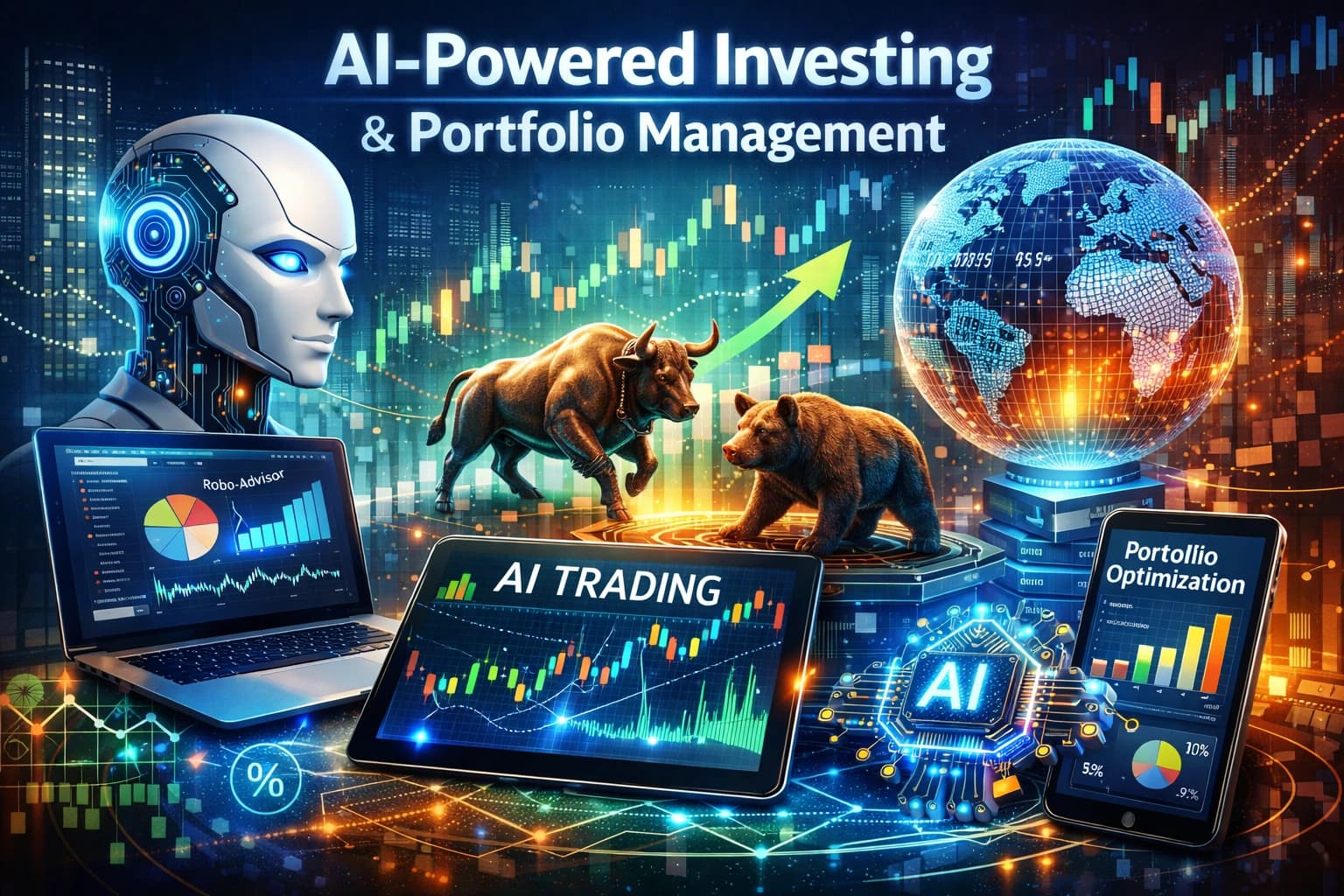
The Technical Reality of AI-Powered Investing and Portfolio Management
A technical examination of machine learning in finance, covering robo-advisors, algorithmic trading, and the mathematical limitations of automated portfolio optimization.
adhikarishishir50
Published on January 23, 2026
The Fundamentals of AI-Powered Investing
AI-powered investing refers to the use of machine learning algorithms and computational statistical models to make financial decisions. This discipline moves beyond traditional rule-based automation. It uses pattern recognition to identify correlations within vast datasets that human analysts cannot process manually. The objective remains the same as traditional investing: maximize returns while minimizing risk. However, the methodology relies on data-driven inference rather than qualitative intuition.
Machine Learning in Finance
Machine learning provides the engine for modern financial analysis. It typically involves three types of learning: supervised, unsupervised, and reinforcement learning. Supervised learning uses historical price data to predict future movements. Unsupervised learning identifies hidden structures in market data, such as grouping similar assets into clusters. Reinforcement learning trains agents to make sequences of decisions, like trade execution, by rewarding profitable outcomes and penalizing losses. These models do not follow a fixed set of instructions. They adapt their internal parameters as new data enters the system.
The Importance of Data Inputs
AI models require high-quality data. Traditional inputs include price, volume, and dividend yields. Modern AI-powered systems also incorporate alternative data. This includes satellite imagery of retail parking lots, shipping logs, and sentiment analysis from news feeds or social media. Natural Language Processing (NLP) allows machines to read thousands of earnings call transcripts and 10-K filings in seconds. The model converts text into numerical vectors to assess the sentiment or tone of corporate leadership. This quantitative approach to qualitative data gives AI models a broader perspective on market conditions.
Mechanisms of Modern Robo-Advisors
Robo-advisors are digital platforms that provide automated, algorithm-driven financial planning services. They require minimal human intervention. Most robo-advisors begin by collecting information from the user regarding their financial goals, time horizon, and risk tolerance through a digital survey. The system then uses this data to recommend a specific asset allocation.
Automated Asset Allocation
Robo-advisors typically use Modern Portfolio Theory (MPT) to build portfolios. MPT focuses on the relationship between risk and return. The algorithm selects a mix of asset classes—usually Low-cost Exchange-Traded Funds (ETFs)—that reside on the 'efficient frontier.' This is the point where an investor receives the highest possible return for a specific level of risk. The AI monitors the portfolio daily. If the market shifts and the asset mix deviates from the target, the system automatically triggers trades to rebalance the portfolio.
Tax-Loss Harvesting Algorithms
One specific advantage of automated systems is tax-loss harvesting. This process involves selling a security that has experienced a loss to offset taxes on investment gains. Doing this manually is labor-intensive and difficult to time correctly. AI algorithms track every 'lot' of shares purchased. When an asset drops below its purchase price, the algorithm sells it to lock in the tax benefit and immediately replaces it with a highly correlated but not identical asset. This maintains the portfolio's risk profile while improving after-tax returns.
Algorithmic Trading and Execution
Algorithmic trading uses computer programs to execute trades at speeds and frequencies that a human trader cannot match. These algorithms follow defined sets of instructions to place trades based on timing, price, or quantity. In many cases, AI models generate the 'signals' that tell the execution algorithm when to buy or sell.
Signal Generation
A signal is a mathematical trigger for a trade. AI models generate signals by analyzing technical indicators, such as moving averages, or by identifying complex patterns in order book data. High-frequency trading (HFT) models look for micro-inefficiencies in the market that exist for only milliseconds. For example, an algorithm might detect a price discrepancy between the same stock trading on two different exchanges and execute an arbitrage trade to capture the difference.
Smart Order Routing
Execution algorithms also focus on minimizing market impact. If a large institutional investor wants to buy one million shares of a stock, a single order would drive the price up. AI-driven smart order routers break the large order into thousands of smaller pieces. They distribute these pieces across different exchanges and dark pools over time. The goal is to achieve the best possible average price while remaining invisible to other market participants.
Advanced Portfolio Optimization
Portfolio optimization is the process of selecting the best proportion of various assets. While traditional methods rely on historical averages, AI uses more sophisticated mathematical frameworks.
Beyond Modern Portfolio Theory
Traditional MPT assumes that market returns follow a normal distribution (the bell curve). However, financial markets often experience 'fat tails,' where extreme events occur more frequently than predicted. Machine learning models, specifically deep learning and neural networks, can account for non-linear relationships and non-normal distributions. These models can adjust to 'regime shifts'—periods when market behavior changes fundamentally, such as during a financial crisis or a sudden change in interest rate policy.
Risk Parity and Factor Investing
AI also facilitates risk parity strategies. Instead of allocating capital based on dollar amounts, risk parity allocates capital based on the risk each asset contributes to the total portfolio. If bonds are less volatile than stocks, the algorithm will hold more bonds to ensure the risk is balanced. Furthermore, machine learning helps identify 'factors'—specific characteristics like value, momentum, or quality—that drive returns. AI can analyze thousands of variables to find new factors that traditional linear models miss.
Limitations and Structural Risks
AI is not a guaranteed path to profit. It has significant limitations that investors must understand. The most common failure in machine learning finance is overfitting. Overfitting occurs when a model is too complex and learns the 'noise' in historical data rather than the actual signal. An overfitted model will perform perfectly on past data but fail miserably in live markets because the patterns it found were coincidental.
Data Quality and Survivorship Bias
Models are only as good as the data they consume. If the historical data contains 'survivorship bias'—meaning it only includes companies that are still in business—the model will overestimate potential returns. Additionally, markets are adversarial. If an AI discovers a profitable strategy, other market participants will eventually find it too. As more money flows into that strategy, the profit margin disappears. This is known as alpha decay.
The Black Box Problem
Many advanced AI models, particularly deep neural networks, are 'black boxes.' It is difficult for humans to understand why the model made a specific decision. This lack of explainability creates risk. If a model begins making irrational trades during a market panic, a human manager might not know whether to trust the machine or shut it down. Regulators are increasingly concerned with this lack of transparency and are pushing for 'Explainable AI' (XAI) in financial services.
The Future of AI in Asset Management
The next phase of AI investing involves the move from fully automated systems to hybrid intelligence. This is often called 'Centaur' investing. In this model, AI handles data processing, pattern recognition, and trade execution, while human managers provide oversight and qualitative judgment. Humans remain better at understanding geopolitical context and unprecedented events that have no historical data for a machine to learn from.
Democratization and Regulation
AI technology is becoming more accessible. Individual investors now have access to tools that were previously reserved for hedge funds. However, this democratization will likely lead to increased regulation. Governments want to ensure that algorithms do not contribute to market volatility or 'flash crashes.' Future systems will likely include built-in 'circuit breakers' and automated compliance checks to ensure the AI operates within legal and ethical boundaries.
Quantum Computing
Looking further ahead, quantum computing represents a significant shift for portfolio optimization. Traditional computers struggle with the 'combinatorial explosion' of trying to find the perfect mix of thousands of assets. Quantum computers can process these calculations almost instantaneously. This could allow for real-time portfolio optimization on a scale that is currently impossible. While this technology is still in its infancy, it is the logical next step for machine learning in finance.
Frequently Asked Questions
How does AI investing differ from traditional quantitative trading?
Traditional quantitative trading relies on static mathematical models and fixed rules defined by humans. AI investing uses machine learning to allow models to improve over time by identifying new patterns in data without explicit reprogramming.
What is overfitting in financial machine learning?
Overfitting happens when an AI model becomes too tailored to historical data, mistaking random market noise for predictable patterns. This leads to high performance in backtests but poor performance in real-world trading.
Can AI-powered robo-advisors beat the market?
Most robo-advisors are designed to track the market or optimize risk-adjusted returns rather than 'beat' the market. They focus on low fees, tax efficiency, and proper asset allocation based on Modern Portfolio Theory.
What is alternative data in AI investing?
Alternative data refers to non-traditional information sources used to gain insights. This includes credit card transactions, social media sentiment, satellite imagery, and weather reports that might impact economic activity.
What is the biggest risk of using AI in portfolio management?
The biggest risk is the 'black box' nature of complex models, which can make it impossible to predict how the AI will react to unprecedented market events or 'black swan' scenarios that were not in its training data.
Explore Topics:
Written By
adhikarishishir50
Author of The Technical Reality of AI-Powered Investing and Portfolio Management