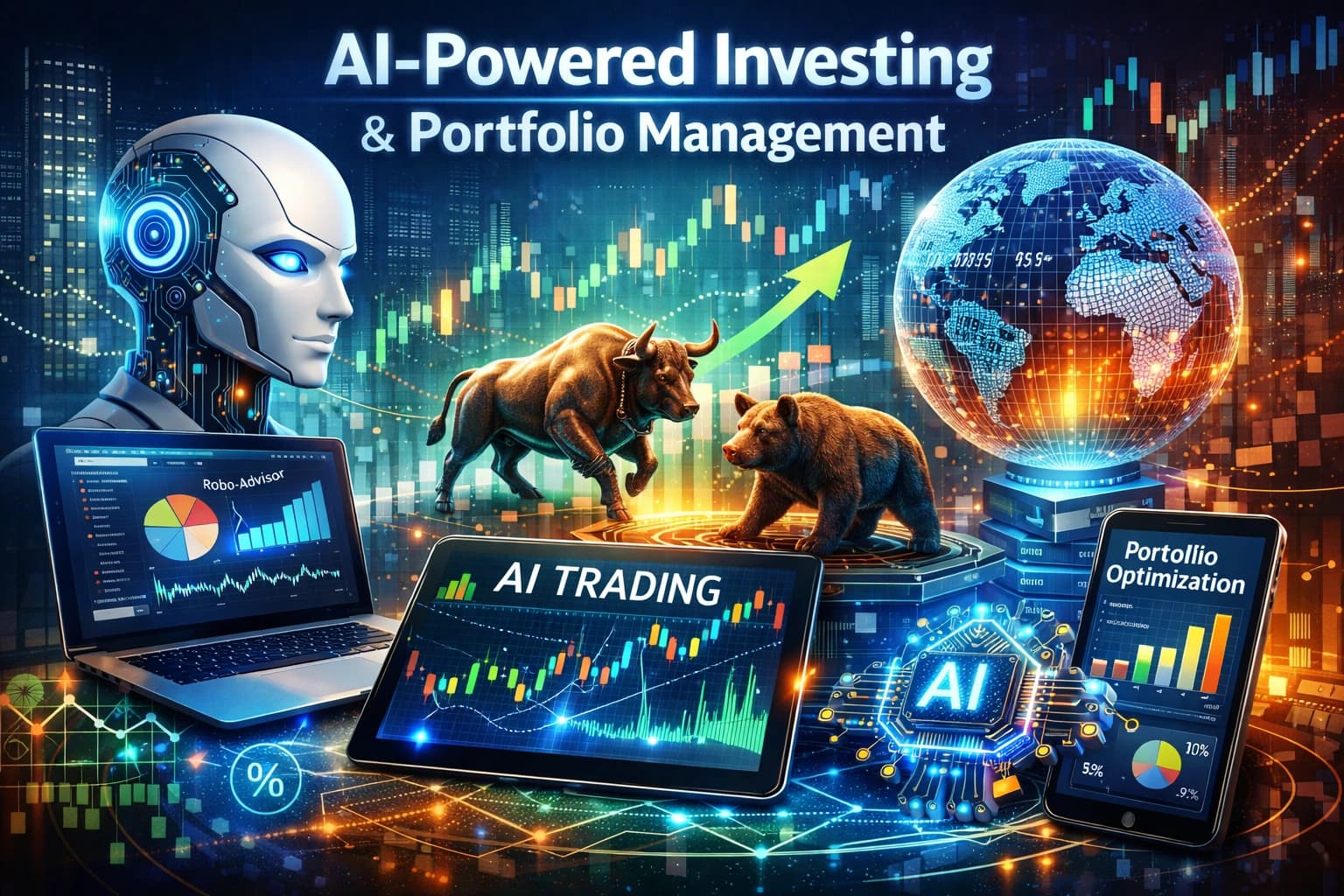
AI-Powered Investing and Portfolio Management: Mechanisms, Limitations, and Reality
A technical breakdown of how machine learning, algorithmic trading, and robo-advisors function within modern financial markets, including their inherent constraints.
adhikarishishir50
Published on January 21, 2026
Defining AI in Financial Management
Artificial Intelligence in finance refers to the application of mathematical models and computational power to process financial data. It is not a single technology. It is a collection of tools including machine learning, natural language processing, and deep learning. These tools identify statistical patterns. They do not possess intuition. They operate on historical data to estimate future probabilities.
Investment firms use these systems to automate decisions that humans previously handled. This shift reduces manual error. It increases the speed of data processing. However, the core objective remains the same: maximizing returns while minimizing risk. AI-powered investing changes the method of achieving this goal, not the goal itself.
The Mechanics of Robo-Advisors
Robo-advisors are digital platforms that provide automated, algorithm-driven financial planning services. They require minimal human intervention. These systems function through a series of logical steps and mathematical frameworks.
Client Profiling and Asset Allocation
The process begins with a risk assessment questionnaire. The software evaluates the user's age, income, financial goals, and risk tolerance. Based on this data, the algorithm selects an asset allocation. Most robo-advisors utilize Modern Portfolio Theory (MPT). MPT aims to construct a portfolio that maximizes expected return for a given level of risk. The system identifies an efficient frontier of investments, typically utilizing low-cost Exchange-Traded Funds (ETFs).
Automated Rebalancing and Tax-Loss Harvesting
Market fluctuations change the weight of assets in a portfolio. If stocks perform well, they may represent a larger percentage of the portfolio than intended. The robo-advisor monitors these weights daily. When a threshold is crossed, the system automatically sells over-weighted assets and buys under-weighted ones. This maintains the original risk profile.
Tax-loss harvesting is another core function. The algorithm identifies securities trading at a loss. It sells these securities to offset capital gains taxes. It then immediately purchases a similar, but not identical, security to maintain the portfolio's market exposure. This process happens continuously, a task that is difficult for human advisors to perform manually across thousands of accounts.
Algorithmic Trading and Execution
Algorithmic trading uses computer programs to execute trades based on defined sets of instructions. These instructions include variables such as timing, price, and quantity. The primary advantage is execution speed and the removal of emotional bias.
Quantitative Strategy Development
Traders write code to exploit specific market conditions. Simple algorithms might use moving averages to trigger buy or sell orders. Complex quantitative strategies use statistical arbitrage. These systems identify temporary price discrepancies between related financial instruments. The algorithm executes thousands of trades per second to capture small price movements. This is often referred to as High-Frequency Trading (HFT).
Order Execution Algorithms
Institutional investors use algorithms to execute large orders without moving the market price. A 'Volume Weighted Average Price' (VWAP) algorithm breaks a large order into smaller pieces. It executes these pieces throughout the day based on historical volume patterns. This prevents 'slippage,' where the act of buying or selling actually changes the price against the investor.
Machine Learning in Finance
Machine Learning (ML) differs from traditional algorithmic trading because it improves over time. Traditional algorithms follow fixed rules. ML models adapt as they ingest more data.
Supervised and Unsupervised Learning
In supervised learning, researchers feed the model labeled historical data. For example, the model looks at ten years of stock prices and economic indicators. It learns to associate certain patterns with subsequent price increases. It then looks for these patterns in real-time data.
Unsupervised learning finds hidden structures in data without pre-existing labels. In portfolio management, this is used for asset clustering. Instead of grouping stocks by traditional sectors like 'Technology' or 'Energy,' the model groups them by how they actually behave in the market. This often reveals that stocks in different sectors are highly correlated, allowing for better diversification.
Natural Language Processing (NLP)
NLP is a subset of AI that reads and understands human language. In investing, NLP models scan news articles, earnings call transcripts, and social media feeds. The system performs 'sentiment analysis.' It assigns a numerical score to the tone of the text. If the sentiment regarding a specific company turns negative, the model can adjust the portfolio's exposure before the news fully reflects in the stock price.
Portfolio Optimization Techniques
Portfolio optimization is the process of selecting the best proportions of various assets. AI enhances this by moving beyond static historical averages.
Black-Litterman Model Integration
The Black-Litterman model combines market equilibrium with investor views. AI improves this by generating 'views' based on massive datasets. The model uses Bayesian statistics to update the probability of an outcome as new information arrives. This results in more stable and diversified portfolios compared to traditional methods that rely solely on historical returns.
Risk Parity and Factor Investing
AI-driven risk parity focuses on allocating risk rather than capital. The system calculates the volatility contribution of each asset. It then adjusts the weights so that each asset class contributes equally to the total portfolio risk. Machine learning identifies 'factors'—such as momentum, value, or low volatility—that drive returns. The system dynamically tilts the portfolio toward the factors expected to perform best in the current economic regime.
Limitations and Points of Failure
AI in investing is not infallible. It operates within strict constraints. Failure to understand these limits leads to significant financial loss.
Overfitting and Backtesting Bias
Overfitting occurs when a model is too complex. It learns the 'noise' or random fluctuations in historical data rather than the underlying signal. An overfitted model performs perfectly on past data but fails in real-time markets. This is a common pitfall in algorithmic trading. If a strategy is backtested until it looks perfect, it likely won't work in the future.
Data Quality and Regime Shifts
AI is dependent on data quality. Inaccurate data leads to 'garbage in, garbage out' scenarios. Furthermore, AI models assume that the future will resemble the past. When a 'Regime Shift' occurs—such as a global pandemic or a sudden change in central bank policy—historical data becomes irrelevant. The model continues to apply old patterns to a new reality, leading to catastrophic errors.
The Black Box Problem
Many deep learning models are 'black boxes.' It is difficult for humans to understand why the model made a specific decision. In a regulated financial environment, this lack of interpretability is a risk. If a model causes a flash crash, investigators and fund managers need to know the 'why.' Without explainability, trust in the system remains fragile.
The Future of AI-Powered Investing
The next phase of AI in finance involves moving toward 'Explainable AI' (XAI). This technology allows human managers to see the logic behind an algorithm's decision. This transparency helps in auditing and risk management.
Quantum computing is also on the horizon. Financial optimization problems are computationally expensive. Quantum computers can process these calculations exponentially faster than classical computers. This will allow for real-time portfolio optimization and more accurate risk modeling across millions of variables.
The role of the human investor is changing, not disappearing. The future belongs to 'Centaur' models—hybrid systems where AI handles data processing and execution, while humans manage strategy, ethics, and high-level risk oversight. AI is a tool for efficiency, but human judgment remains the final arbiter of value.
Frequently Asked Questions
How does a robo-advisor differ from a human financial advisor?
A robo-advisor uses mathematical algorithms to manage assets based on fixed rules like Modern Portfolio Theory. It excels at technical tasks like daily rebalancing and tax-loss harvesting. A human advisor provides holistic financial planning, emotional guidance during market volatility, and complex estate planning that software cannot yet replicate.
Can AI predict a stock market crash?
AI cannot predict a crash with certainty. It identifies high-risk environments based on historical patterns of volatility and economic indicators. However, AI models often fail during 'Black Swan' events because these events have no historical precedent in the training data.
What is the biggest risk in algorithmic trading?
The biggest risk is 'overfitting.' This happens when an algorithm is so finely tuned to past data that it cannot adapt to new, different market conditions. This leads to a model that looks profitable on paper but loses money in a live environment.
How does sentiment analysis impact investment decisions?
Sentiment analysis uses Natural Language Processing to quantify the tone of news and social media. If the data shows a sharp increase in negative sentiment, an AI-powered system may reduce exposure to that specific asset before the technical price indicators reflect the change.
Explore Topics:
Written By
adhikarishishir50
Author of AI-Powered Investing and Portfolio Management: Mechanisms, Limitations, and Reality