AI-Powered Investing and Portfolio Management: Mechanisms and Limitations
An authoritative technical guide on how machine learning, robo-advisors, and algorithmic trading define modern financial portfolio management.
adhikarishishir50
Published on January 20, 2026
The Fundamentals of AI-Powered Investing
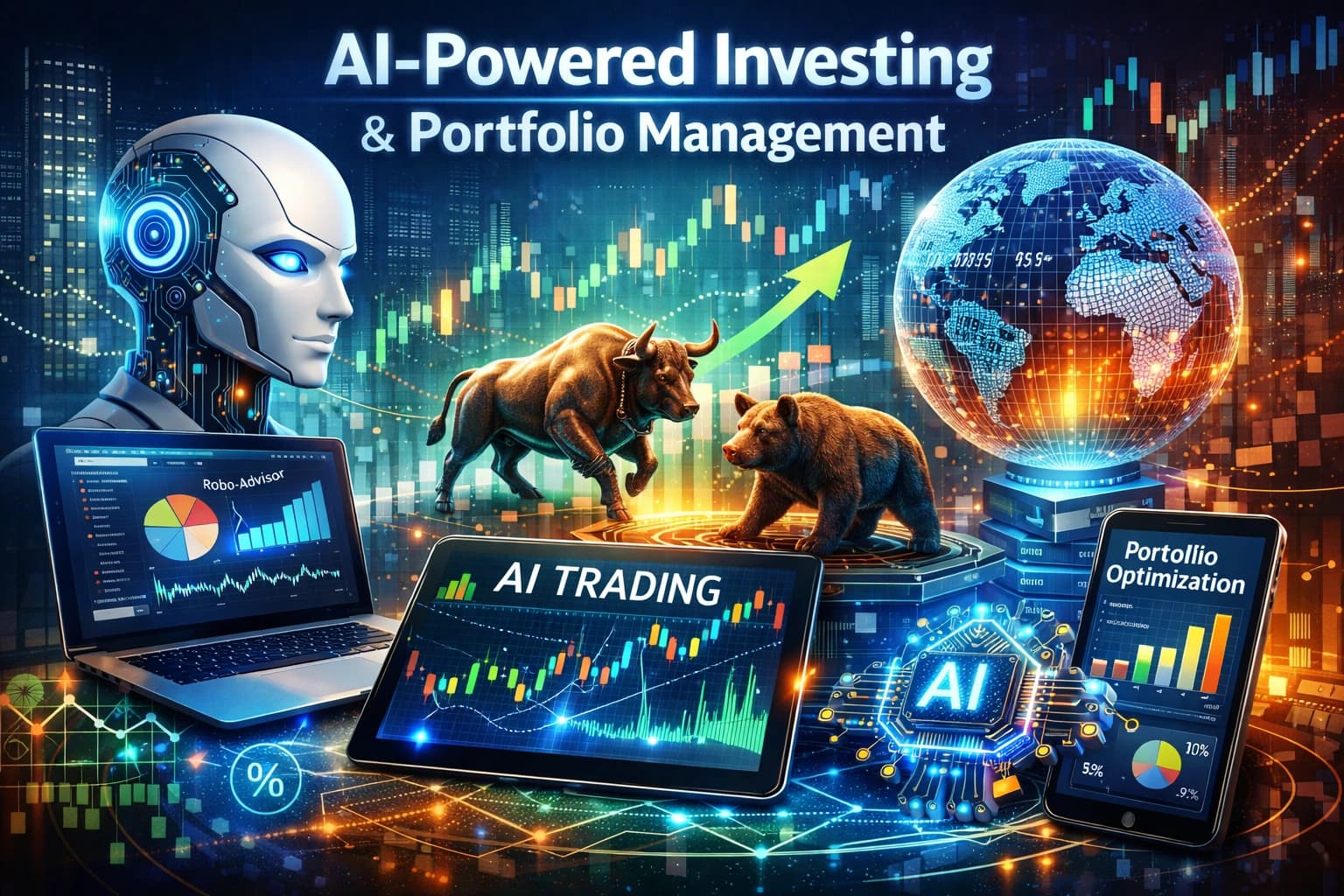
Artificial intelligence in finance refers to the application of machine learning models and automated algorithms to manage capital. It shifts the burden of data processing from human analysts to computational systems. This transition aims to increase speed, reduce emotional bias, and identify patterns within massive datasets. Modern investing relies on several core technologies: robo-advisors, algorithmic trading, and advanced portfolio optimization techniques.
Defining the Core Components
Robo-advisors represent the most accessible layer of AI investing. These platforms use algorithms to automate the distribution of assets based on a user’s risk profile. Algorithmic trading operates at a deeper level, executing specific buy and sell orders based on pre-defined criteria. Machine learning in finance involves training models to recognize non-linear relationships in market data that traditional statistical methods might miss.
How AI Investing Systems Function
AI systems do not predict the future with certainty. They calculate probabilities based on historical data and real-time inputs. The process generally follows a specific pipeline: data ingestion, feature engineering, model training, and execution.
Robo-Advisors and Automated Allocation
Robo-advisors typically utilize Modern Portfolio Theory (MPT). The system asks the user questions to determine their time horizon and risk tolerance. It then allocates capital across various asset classes, usually through low-cost Exchange-Traded Funds (ETFs). The primary mechanism here is automated rebalancing. If an equity position grows beyond the target percentage, the software automatically sells a portion and buys underweighted assets to maintain the original risk profile.
Algorithmic Trading Mechanisms
Algorithmic trading systems execute trades at speeds and frequencies impossible for humans. These systems monitor variables such as price, timing, and volume. Simple algorithms follow trend-following strategies or mean reversion. Advanced systems use Natural Language Processing (NLP) to scan news headlines and social media sentiment. If the algorithm detects a negative sentiment trend for a specific stock, it can trigger a sell order in milliseconds.
Portfolio Optimization through Machine Learning
Traditional optimization focuses on the mean-variance relationship. AI-driven optimization goes further by using supervised learning to predict asset returns and unsupervised learning to cluster assets with similar behaviors. This allows for more precise diversification. Instead of just diversifying by industry, the system diversifies by latent risk factors that are not immediately obvious to human observers.
The Role of Data in Financial Models
Data serves as the fuel for AI investing. Models ingest structured data, such as historical price charts and corporate earnings reports. They also ingest unstructured data, including central bank transcripts and satellite imagery of retail parking lots. Machine learning algorithms, specifically deep learning and neural networks, process this information to find correlations. For example, a model might find that a specific weather pattern in the Midwest correlates with price fluctuations in agricultural commodities two months later.
Limitations and Risks of AI in Finance
AI investing systems are not infallible. They face significant structural and mathematical limitations. Understanding these gaps is essential for any professional managing capital via automated systems.
The Problem of Overfitting
Overfitting occurs when a model learns the noise in historical data rather than the underlying signal. An overfitted model performs exceptionally well on past data but fails in live markets. This happens because the model assumes that every historical anomaly is a rule that will repeat. When market conditions shift, the overfitted model makes incorrect predictions.
Black Swan Events and Structural Breaks
AI models rely on historical patterns. They struggle with "black swan" events—rare, unpredictable occurrences that have never happened before. Because the model has no data on these events, it cannot calculate their probability accurately. Furthermore, markets undergo structural breaks, such as changes in government regulation or geopolitical shifts. These breaks render historical data irrelevant, causing models to operate on obsolete assumptions.
Execution Latency and Slippage
Even the best algorithm faces physical limits. In high-frequency trading, the time it takes for a signal to travel through fiber-optic cables matters. Slippage occurs when there is a difference between the expected price of a trade and the price at which the trade actually executes. In volatile markets, AI systems may trigger trades that cannot be filled at the desired price, leading to unexpected losses.
The Black Box Problem
Many deep learning models are "black boxes." This means even the developers cannot easily explain why the model made a specific decision. In a regulated financial environment, this lack of transparency is a risk. If a model causes a flash crash, regulators and stakeholders need to understand the logic behind the failure. Explainable AI (XAI) is an emerging field attempting to solve this, but it remains a work in progress.
The Future of AI-Powered Investing
The next phase of AI in finance involves moving beyond simple automation toward more adaptive systems. This includes the integration of Reinforcement Learning (RL), where agents learn through trial and error within a simulated environment to maximize cumulative rewards.
Explainable AI and Regulatory Compliance
Future systems will prioritize transparency. New frameworks will likely require AI models to provide an audit trail for every trade. This will move the industry away from opaque neural networks toward models where humans can trace the logic of an investment decision. This is critical for institutional adoption.
Quantum Computing Potential
While still in the early stages, quantum computing could fundamentally change portfolio optimization. Quantum computers can solve complex combinatorial problems much faster than classical computers. This would allow for the simultaneous optimization of thousands of variables in real-time, providing a level of precision currently unattainable.
Personalization at Scale
AI will enable hyper-personalized portfolios. Instead of standard risk categories, systems will build portfolios based on specific individual constraints, such as tax optimization requirements, ethical preferences, and specific career-related risks. This level of customization was previously reserved for high-net-worth individuals but will become standard through AI-driven platforms.
Conclusion
AI-powered investing provides significant advantages in data processing and execution speed. It removes human emotion from the decision-making process and allows for sophisticated portfolio management at a lower cost. However, these systems are limited by the quality of their data and their inability to navigate unprecedented market events. A professional approach requires a clear understanding of both the mathematical power and the inherent risks of these technologies.
Frequently Asked Questions
What is the difference between a robo-advisor and algorithmic trading?
A robo-advisor focuses on long-term asset allocation and automated rebalancing for individual investors. Algorithmic trading focuses on executing specific trades at high speed based on technical triggers or market signals.
Can AI predict market crashes?
AI can identify patterns that historically preceded crashes, but it cannot predict 'black swan' events or unprecedented market shifts because it relies on historical data to make its calculations.
What is overfitting in financial machine learning?
Overfitting occurs when a model is trained too closely on historical data, capturing random noise rather than meaningful patterns. This leads to high performance on past data but failure in real-world trading.
How does Natural Language Processing (NLP) affect trading?
NLP algorithms scan news reports, earnings calls, and social media to gauge market sentiment. They convert unstructured text into data that can trigger buy or sell orders based on the detected tone.
Explore Topics:
Written By
adhikarishishir50
Author of AI-Powered Investing and Portfolio Management: Mechanisms and Limitations